Some more adjustments to the main home page. Had been using RRSdog.com to pull the Environment Canada Weather Alerts, but they had some outages today, so AI and I tackled how to run it on my web server. Also updated the code to now show the new Environment Canada Weather colour codes when weather alerts happen. This will make it more noticeable when an alert happens.
A hardware change, I’m testing a new sky cam option. Had found out that the low cost (under $50) Wyze V3 cameras support RTSP connections. This allows me to run a script to pull an image off the camera and then upload it to the website. Most Wyze cameras only work with Wyze’s app. Not sure if the camera will survive Alberta winters. Will see if this becomes permanent. The original skycam (a Logitech webcam from 2012 running on Windows XP embedded) will continue to run and provide the webpage background image and backup if the Wyze camera fails.
Think I’m done the homepage modernization project for now. Let me know if anything glitches for you.
Enjoy the updates and happy weather watching!
Additional Home Page updates and testing new skycam
March 25th, 2026 Posted in Site News
Massive Weather Home Page Upgrade
March 17th, 2026 Posted in Site News
For years, I’ve known there were issues with my weather station website’s layout, especially on mobile devices. I made several attempts to fix them but could never quite get things working the way I wanted.
With the help of AI, I was finally able to clean up the code and make significant improvements. Thanks to Google Gemini, the homepage is now far more mobile-friendly and responsive. Formatting issues have been resolved, and the layout now scales properly on larger displays.
I hope you enjoy the updates, and as always—happy weather watching!
Cheers, Jeff
With the help of AI, I was finally able to clean up the code and make significant improvements. Thanks to Google Gemini, the homepage is now far more mobile-friendly and responsive. Formatting issues have been resolved, and the layout now scales properly on larger displays.
I hope you enjoy the updates, and as always—happy weather watching!
Cheers, Jeff
Good Davis WX resource
March 14th, 2026 Posted in General Interest
Been doing some research lately and found this good resource for the Davis weather stations. So just saving the link here for future self.
Manual: https://www.manula.com/manuals/pws/davis-kb/1/en/topic/general-please-read
Some Notes
Interesting info on Barometer Pressure.
https://www.manula.com/manuals/pws/davis-kb/1/en/topic/pressure-reading-problems
The intrinsic accuracy of the barometric pressure readings for both Vue and VP2 stations is quoted as ±1mb or ±0.03“Hg and, once calibrated, most units will track other high-quality pressure readings in the locality pretty well and to within this nominal accuracy. There may be some long-term drift, in which case an occasional recalibration against a reference reading should fix any slight problem.
However, stations that are located at significant altitude (eg 1000-2000ft and above) may experience more frequent discrepancies against reference readings. This is not necessarily caused by any fault with the console but can arise because of the way that corrections are made from the measured local pressure back down to sea level. (The more elevated the location, the greater any sea-level correction will be, which is why this issue is usually only noticeable at stations located at significant altitude.)
When I compare my barometer readings to what Windy.com is showing for this area, my station is within 1mb. I do puzzle why so many other personal weather stations in the area are so different. Maybe they have drifted or not been calibrated correctly or is mine off. Since I cannot compare to an official calibrated one, I tried to calibrate mine to the airports in the area on a stable air pressure day.
Another topic of exploration was if I could move my UV and solar sensors to the anemometer mount point so they would never be in the shade. The sensor transmitter has plugs for UV and Solar, but found this text stating that it would not work.
https://www.manula.com/manuals/pws/davis-kb/1/en/topic/uv-sensor
Other transmitters: Users often notice that supplementary transmitters such as the 6332 Anemometer Transmitter or the 6372 or 6382 Temperature Stations use exactly the same transmitter board as the ISS, which therefore has sockets to connect solar or UV sensors. Regrettably you cannot use these supplementary solar/UV inputs. The reason is that solar/UV data must be received by the standard VP2 console as ISS data and the VP2 system allows only one ISS per station. (The supplementary stations will in fact transmit the solar/UV data, but this can only be received by eg an Envoy8X or Meteobridge Pro Red unit.)
Autumn Maintenance
September 21st, 2025 Posted in Site News
Comments Off on Autumn Maintenance
Finally got around to replacing the 24 hour fan for the temperature sensor. Hoping these new batteries get the fan spinning properly again and my temperature readings become more accurate.
To replace them, I had to pull the full base station apart, so gave it a good clean. It had been many years since I gave it a full clean. Was showing it, so much dirt and spider webs.
Tried so hard to not bump the rain sensor, but right at the end, oops. 0.2mm measured.
Few photos of the dirty unit.
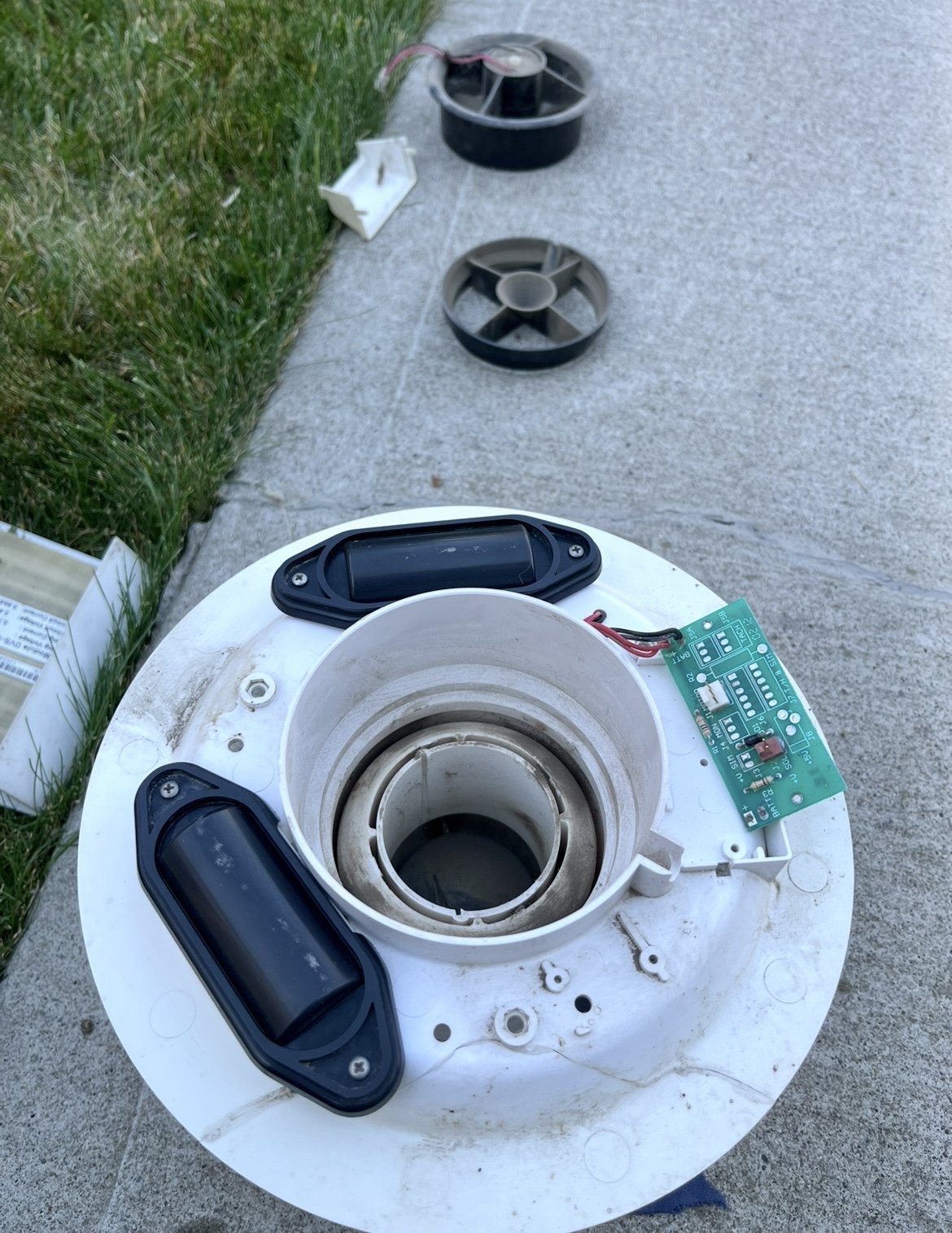
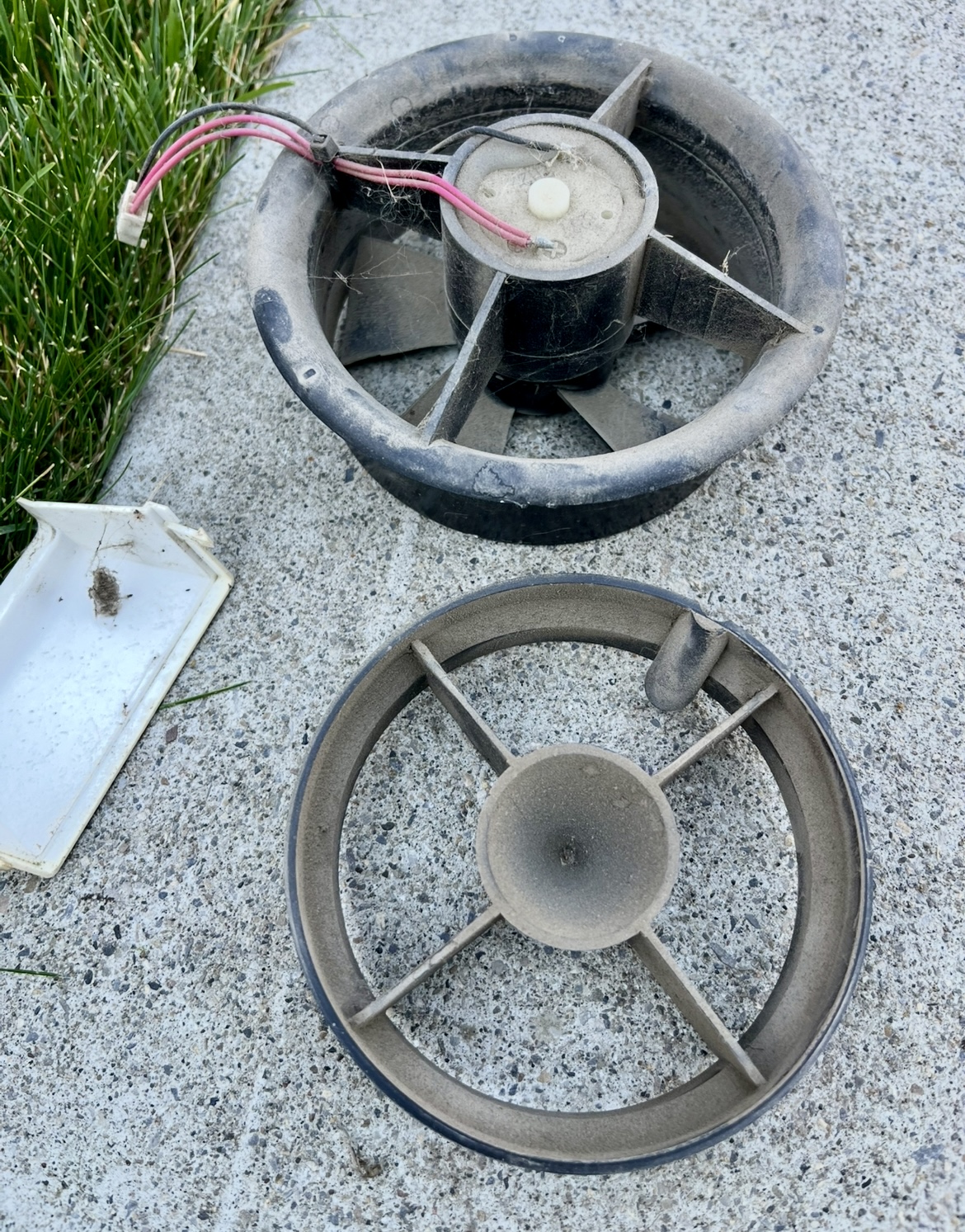
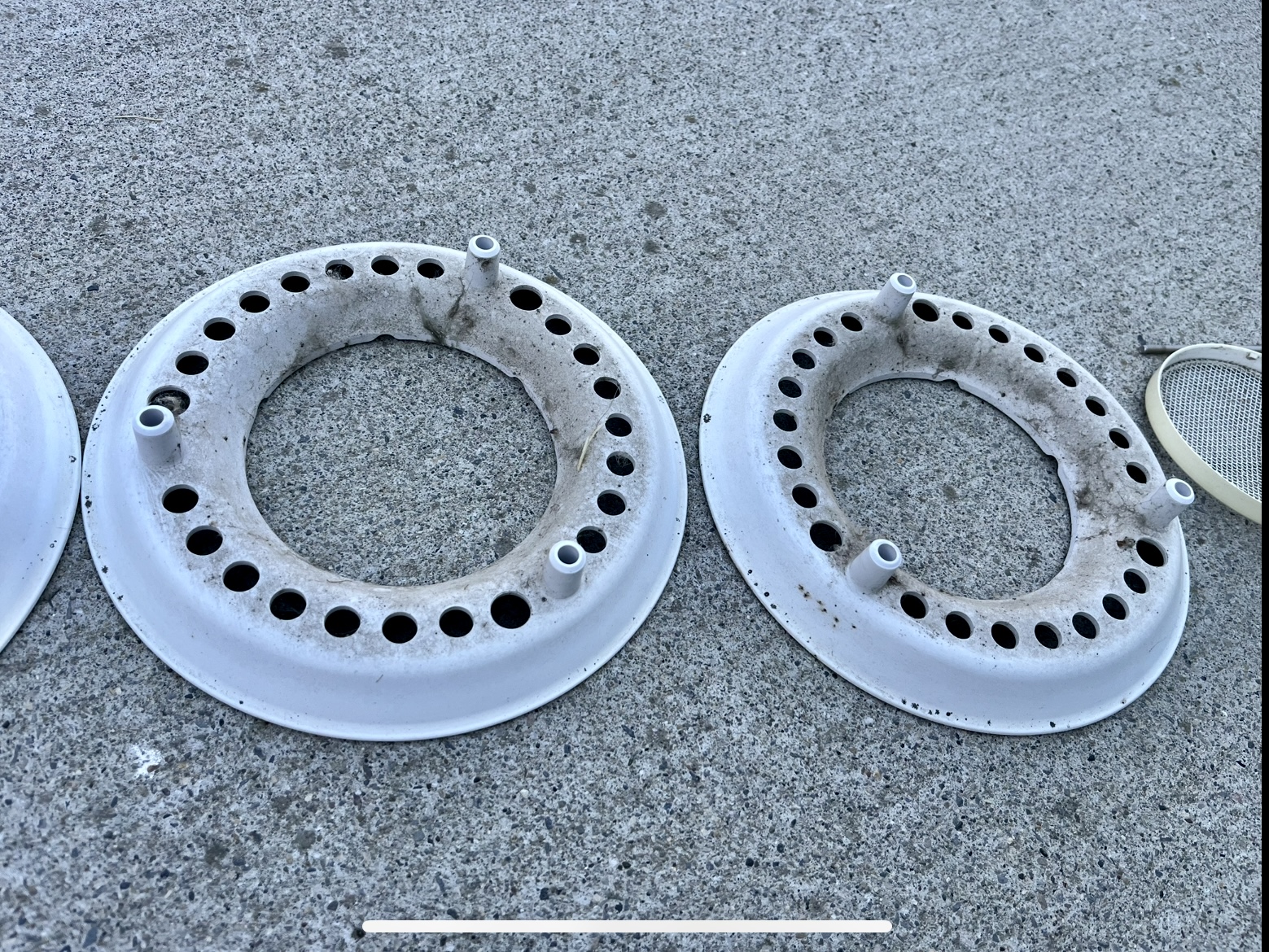
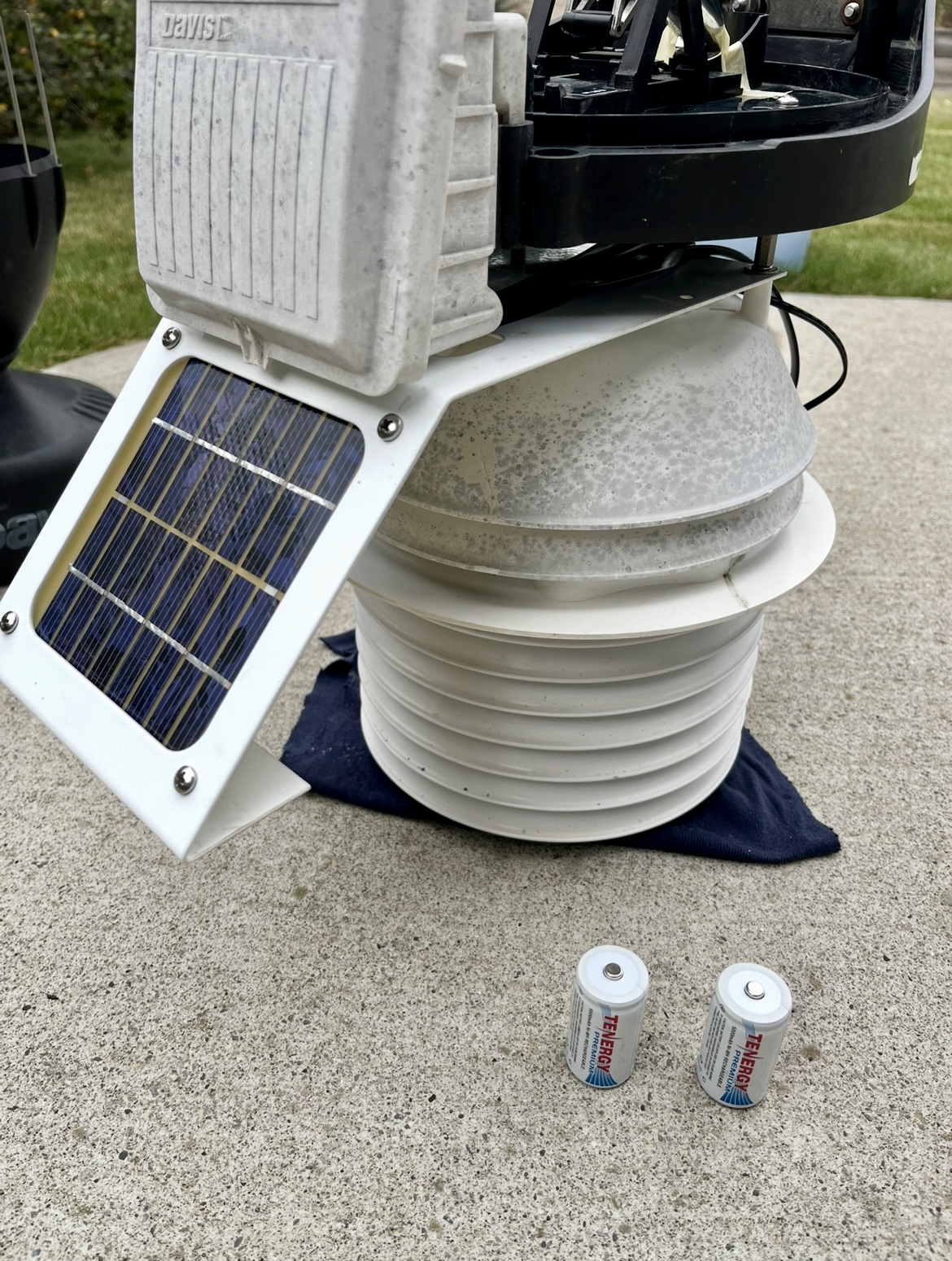
All clean and back together. Plastic is really deteriorating on the sensor cover and top of the temperature housing. Weather Station has been operation for 13 plus years now! The Oregon Scientific I had before this one deteriorated in 6 years and the plastic was so brittle, parts were breaking. Highly recommend the Davis Weather stations.
Replaced Batteries
October 19th, 2024 Posted in Site News
Comments Off on Replaced Batteries
Installed new backup lithium batteries both the anemometer transmitter and the main temp/rain/solar sensor transmitter.
Noticed the 24 hour Fan-Aspirated batteries are worn out and not keeping the fan running when lack of sunlight on the solar panel. On the repair todo list.
Data outage
June 28th, 2024 Posted in Site News
Comments Off on Data outage
Didsbury had a massive thunderstorm last night (June 28, 2024) around 2-3am. It knocked the power out for a second and ended up scrambling the weather console and network upload module. A full reset this morning got it working again.
I have a second console gathering the same data, so I was able to add the rainfall we got after the uploading console was put offline. Data I couldn’t upload are the daily max wind gust of 47km/h at 2:24am. We also had a max rain rate of 113.0mm/hr at 2:27.
First time I’ve had the weather console glitch like that.
False Rain – station cleaning
June 25th, 2024 Posted in Site News
Comments Off on False Rain – station cleaning
I was cleaning the spider webs and nests from the rain gauge and bumped the rain gauge and caused it to rain 0.4mm at 6pm today.
New Web Address!
January 15th, 2024 Posted in Site News
Comments Off on New Web Address!
www.didsburywx.ca
Well, I finally gave my personal weather site it’s own Internet address. For years the weather stuff was part of my side business BlueVistaVentures.ca. I had helped a few people build and configure personal weather stations and websites. Now that I’ve retired the business, it is time to clean up 16 years of linkage and systems.
What is with the address name? Well, the first bit is obvious, the town the weather station is in. Didsbury, Alberta, Canada. The WX is morse code shorthand for the word weather. So it is commonly used as the abbreviation for the word weather. So the address is translate to: DidsburyWeather.Canada
Not to be confused with the township of Didsbury, UK, which is now a suburban area of Manchester, England. Which Didsbury, Alberta is named after.
Please update your bookmarks to the new address. The existing weather.bluevistaventures.ca will continue for another year or so.
Happy weather watching! Cheers, Jeff
Coldest air temperature recorded at this location
January 14th, 2024 Posted in Weather News
Comments Off on Coldest air temperature recorded at this location
On January 13 and 14, 2024 my weather station located in Didsbury, Alberta within the Rosebud Creek valley, Valarosa Crossing neighbourhood, recorded the lowest air temperatures of -40° Celsius. This has been the lowest ever recorded by my weather station since installation back in August 2012. Previous record was -39° Celsius back on February 7, 2021.
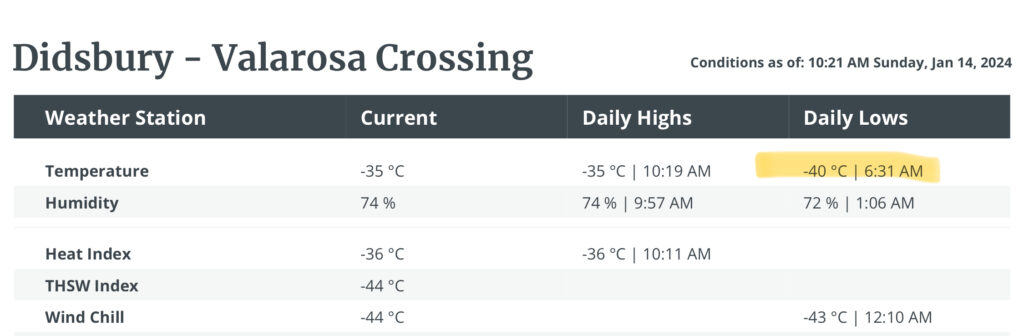
The weather station has struggled to transmit data during these extreme cold hours in darkness. The backup lithium batteries, that keep the system running when the solar panels cannot power it, are only a year and half old, but maybe the solar panel batteries have lost some of their power and therefore cause the backup batteries to be used more. New batteries will be installed soon.
Anemometer offline – battery issues in the cold
January 12th, 2024 Posted in Site News
Comments Off on Anemometer offline – battery issues in the cold
The anemometer lithium backup battery doesn’t have enough power to send the data in this -37°C weather we are having. Stopped sending data at 4am. Although, it did find a bit of juice to send again at 5:30am. I had replaced the battery in June 2022, which should still be good. Replacement is now on the todo list this summer, when I can climb up onto the roof.
Once the sun gets up, power will be restored and wind speed and directions should start reporting again.
